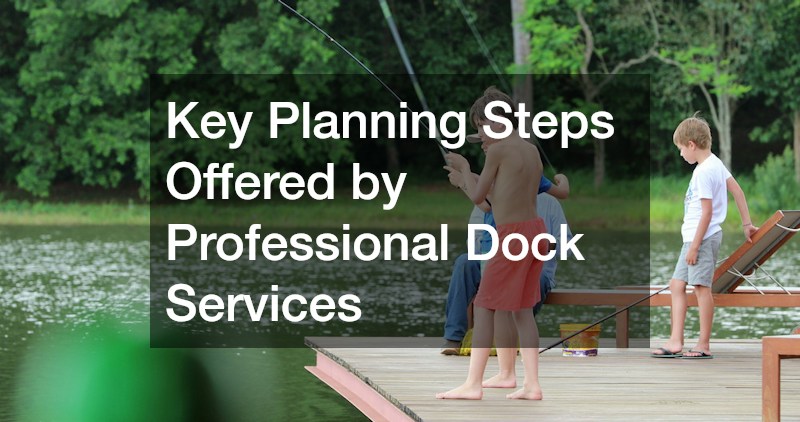
A professional dock service provides the technical expertise, regulatory knowledge, and project management necessary to build safe, durable, and legally compliant waterfront structures. From initial site evaluation to material selection and permitting, a structured planning process prevents costly construction delays, ensures structural longevity, and guarantees the finished dock withstands environmental pressures such as wave action, ice, and tidal fluctuations.
Comprehensive Site Assessment and Feasibility Analysis
Before designing a dock, professional marine contractors conduct an in-depth site analysis to establish structural and environmental constraints. They measure water depth profiles, seasonal water level variations, wave climate, and current velocity to determine whether a fixed piling dock or floating dock system is most appropriate.
Additionally, professionals assess benthic and shoreline conditions to guide proper foundation engineering, checking soil composition, bedrock depth, and bank stability. They also evaluate official property lines and riparian rights to ensure the proposed structure stays within designated property limits and complies with mandatory setback distances from neighboring lots.
Custom Engineering and Structural Design
Professional dock design balances structural integrity, operational utility, and aesthetic preferences:
-
Dock Type Selection: Floating docks adjust automatically to fluctuating water levels, making them ideal for deep-water or tidal zones. Fixed piling docks offer superior stability in shallow, consistent-depth water or areas prone to heavy wave action.
-
Load Calculations and Configuration: Engineers design layouts—such as I-shape, L-shape, or U-shape configurations with integrated boat slips—based on intended use, vessel displacement, equipment loading, and foot traffic requirements.
-
Safety Integration: Incorporating critical safety features, including non-slip composite decking, protective bumpers, rub rails, underwater LED lighting, and sturdy handrail systems, prevents accidents and protects vessel hulls during docking maneuvers.
Material Selection Based on Environmental Exposure
Selecting the appropriate material directly impacts the dock’s operational lifespan and long-term maintenance requirements:
-
Pressure-Treated Marine Timber: Traditional and cost-effective, but requires routine sealing, staining, and inspection to prevent splintering, warping, rot, and marine borer damage.
-
Marine-Grade Aluminum: Lightweight, highly corrosion-resistant, and low-maintenance. Aluminum structural frames provide exceptional strength without adding excessive dead weight to floating systems.
-
Composite Decking: Synthetic or wood-plastic composites offer rot resistance, splinter-free surfaces, and UV stability, though they require rigid underlying structural framing support to prevent sagging.
-
High-Density Polyethylene (HDPE): Frequently used for floating dock pontoons, modular floats, and drive-on boat or personal watercraft (PWC) lifts due to its impact resistance and complete chemical inertness in salt and fresh water.
Permitting and Regulatory Compliance Management
Navigating local, state, and federal regulations is often the most complex phase of dock planning. Professional dock builders manage approval workflows across multiple governing agencies to secure environmental protection permits for fish habitat preservation, shoreline erosion control, and wetlands protection.
They also coordinate with federal and regional authorities, such as the U.S. Army Corps of Engineers (USACE) or state departments of natural resources, for structures placed in navigable waterways. Furthermore, marine contractors ensure full compliance with local municipal zoning ordinances, including setback rules, maximum square footage limits, roofed slip restrictions, and electrical safety codes for shore power installations.
Construction Scheduling and Timeline Alignment
Developing a resilient construction schedule accounts for environmental conditions and regulatory restrictions:
-
Environmental Work Windows: Aligning heavy construction and pile-driving activities with approved “in-water work windows” minimizes disruption to local fish spawning cycles and fragile aquatic habitats.
-
Seasonal Weather Planning: Scheduling piling installation and major framing during favorable weather or low-water seasons prevents hazardous working conditions and structural misalignment.
-
Contingency Management: Building buffer periods into the project timeline mitigates unexpected delays caused by material supply chain lead times, adverse weather events, or extended municipal permit review periods.
Post-Construction Maintenance Planning and Inspection
Protecting your waterfront investment requires an ongoing care strategy established at project completion. Professional marine services set up routine inspection schedules to evaluate hardware tightness, cable tension, floating drum integrity, and piling health following major storm events. They also design adaptable, modular structures that allow for easy future expansion—such as adding boat lifts, kayak launches, or extra slips—as your recreational needs evolve.
Engaging a professional dock service transforms a complex waterfront project into a structured, manageable process. By combining site-specific engineering, durable material selection, and rigorous permit navigation, professionals ensure your dock delivers long-term safety, regulatory compliance, and functional performance. Investing in comprehensive upfront planning protects both your financial outlay and the surrounding aquatic ecosystem for decades to come.
Related Posts

The Everyday Work Routine of an Electrician
Understanding the essential tasks and activities of an electrician can provide insight into their critical role in maintaining and installing…

The Importance of Assuring Your Home Is Free of Asbestos
Asbestos is a naturally occurring mineral that was once widely used in building materials. It is known for its heat…

Understanding the Process of Aluminum Brazing
Aluminum brazing is a critical process in various industrial applications, serving as a cornerstone in the production of high-quality metal…